Wednesday, May 29, 2013

Buffalo Robe Beds

On a tour last summer of the Louis Bolduc House in Colonial Ste. Genevieve, I noticed a child's bed with a buffalo robe sitting atop a simple mattress.  Here is an old photograph of the family bedroom, however the bed that caught my attention would be located nearly where the photographer is standing and is out of the picture:


Louis Bolduc House Bed Chamber ca. 1792-1793

Although the Bolduc House is a bit later than my area of interest as a 1750's French habitant from the Village of Kaskaskia, it did get me to think about French Colonial bedding and the commonality of buffalo robes being used in a habitant's home.

So the questions for today are:


Would a 1750's Kaskaskia habitant have used a buffalo robe for bedding? 

If so, should I use a buffalo robe for my living history impression? 

Of course the easiest (and my favorite) method of determining the plausibility of this is to consult the notarial records, specifically the house inventories of deceased individuals.

While going through some of the inventories found in Belting's book, Kaskaskia Under the French Regime, I noticed an interesting pattern in the choice of bedding for the Illinois habitant (pg. 45):

An inventory of September 1725:

1 bed with 1 feather bead with 2 buffalo robes
2 pairs of bed curtains containing altogether 10 ells
1 pair of bed curtains of brown stuff, 10 ells
...


In a separate list of household goods (pg. 46):

Francois Bastien, a habitant of Prairie du Rocher, left these household goods, according to the inventory made June 10, 1763:

3 buffalo robes, 3 pillows, 1 cot
1 bed, 1 robe, 1 coarse wool blanket, 1 pillow
...


Even as early as 1704 in Kaskaskia, hides appear in the estate of Jacques Bourdon (pg. 66):


4,443 pounds of beavers
84 deerskins
12 doeskins
6 buffalo hides
10 otter skins
54 pounds of tallow

A quick look at three inventories from a huge timespan of 1704 to 1763 shows that buffalo hides were available.  Even better, the 1725 and 1763 inventories list "buffalo robes" with other bedding items such as pillows, beds, blankets and cots.  Things are looking good at this point...


Mary Elizabeth Good shares a report entailing the trading procedures among the French and Indians in Guebert Site: An 18th Century Historic Kaskaskia Indian Village (pg. 34):

1723, Diron d’Artaguiette, Inspector-General for the Company (of the West), came to the area on an inspection tour:

The trade of the inhabitants of the Ilinnois, who are Canadians, French or discharged soldiers, consists in selling their wheat and other products to the company for the subsistence of the troops, in exchange for merchandize (which they are obliged to fetch from New Orleans) which they trade to the Indians for quarters of buffalo, bear oil and other meats, which serve them for food or which they sell in exchange for merchandize.  They also trade in skins, such as beaver, buck and deer, buffalo and bear skins, and other peltries, which they get very cheap from the Indians, and which they sell at a very high price to the traders who come down from Canada every spring and autumn, and who give them merchandize in exchange.  For it is not necessary for them to rely upon having their needs supplied from New Orleans, whence very few convoys come, and even when they do come they bring so few merchandizes that they are not nearly sufficient to pay a part of the debts which the company is obliged to incur every year. 

To me, it looks like d'Artaguiette is suggesting that the buffalo pelts are pretty cheap and plentiful, therefore I believe it stands to reason it would be a common thing to use for a bedspread.  The buffalo robe's modern equivalent is the "Bed in a Bag" or the micro-fleece throw that just about everyone has thrown across the back of the couch.  Both are available at your local Wal-mart or Target.  However, buffalo robes are not! 

Just this little bit of research scratched the surface of something much deeper and eye-opening for me.  We have all been taught the "Buffalo were very important to Native Americans.  They used their stomachs for kettles and boiled buffalo soup by throwing in hot rocks."  Yes, this is true, but what struck me was how the "sauvage" (French for wild/untamed i/e the Indian and from silva, which is Latin for from the forest) became so quickly "Frenchified" once European contact in the area commenced.  I wouldn't say this is an evolution in culture, this is a quick mutation of culture over just a generation or two.  It has opened up an interest in the native side of reenacting for me and I hope to make acquaintances with some good native historians to share ideas and so that I may learn more.  The good part is that this is helpful with my habitant impression because the two cultures are so intertwined and interdependent that I should have a better knowledge of the sauvage.


… The Ilinnois are in general the handsomest and the best built savages that I have seen.  Proud and arrogant at home, they are the most cowardly of men when they are out of sight of their own village.  They live on maize and their hunt, which consists of buffalo, deer, roe, wild turkeys and other game, which is in abundance.  They clothe themselves and also their women with buffalo skins, which they dress on the flesh side and leave the hair which is long and fine, but after a while when the French came among them, they began to learn the French way of dressing.  (Good, pg. 34)

This side-tracking of research showed that the natives where adept at weaving clothing from the spun hair of the buffalo and early French businessmen thought there might be a market in France for clothing made from buffalo wool.  The buffalo was to be the French "golden goose", but the difficulty involved in processing the wool and factors in shipping did not make it a cost-effective venture.  It looks as though the buffalo was a cheap source of meat, leather and fur for those already in the Americas.  

Now to answer the earlier question:  

Given the following:
  • A prevalence of buffalo hunting by both the native people and the French
  • The existence of trade records of buffalo hides being and shipped throughout New France  
  • The widely recorded use of buffalo robes by the native people, including the Kaskaskia people 
  • Most notably, the household inventories of French settlers that encompass my target date of 1750 
The use of a buffalo robe in my living history impression would be a pretty safe item to use.  

So I set out to find a buffalo robe for my camp.  At the time, there was a baby on the way and my budget was (and still is...) on the low side of buffalo robes.  I really figured the robe I could afford would end up looking like a picture of those scary hairless cats that gets posted around the internet.  Off to Ebay I went with my little bid...

A beautiful, large, thick robe was listed and just for the heck of it, I put in my bid.  Of course it wasn't even close to the reserve price, but I tried.  A few days later, the seller contacted me.  She had noticed that my username on Ebay had a "history reenactor" feel about it and wondered if I was into reenacting.  I showed her this blog and explained what I was planning with the buffalo robe.  In return, she shared memories of her late brother's love of reenacting.  He had purchased two buffalo hides to use in his western fur trade camp.  Unfortunately, he passed away too soon to fully enjoy the hides and she wanted to offer them to a fellow reenactor.  We made an agreement that I would use the hides and keep them in a living history camp as they were originally intended.  I'm honored to own them and made a wonderful friend out of the deal!  

Once I get a good photo of my robes, I will remove this stock photo. 


Duke is checking out the new robe in the living room


The robes made their first trip to Fort de Chartres during the November encampment.  I don't know the overnight low temperature, but there was a fair amount of ice in my trade kettle, which I had full of water the previous night.  With one robe above me and another robe under me on my bed of straw, I have never been so warm when camping in below-freezing temperatures.  Not even when using modern sleeping bags.  I now understand how Le Page du Pratz felt:

My companions soon raised a cabin, well-secured to the North. As we resolved to continue there for eight days at least, they made it so close as to keep out the cold: in the night, I felt nothing of the severity of the North wind, though I lay but lightly covered. My bed consisted of a bear's skin, and two robes or coats of buffalo; the bear skin, with the flesh side undermost, being laid on leaves, and the pile uppermost by way of straw-bed; one of the buffalo coats folded double by way of feather-bed; one half of the other under me served for a matrass, and the other over me for a coverlet: three canes, or boughs, bent to a semicircle, one at the head, another in the middle, and a third at the feet, supported a cloth which formed my tester and curtains, and secured me from the injuries of the air, and the stings of gnats and moskitto's. My Indians had their ordinary hunting and travelling beds, which consist of a deer skin and a buffalo coat, which they always carry with them, when they expect to lie out of their villages. We rested nine days, and regaled ourselves with choice buffalo, turkey, partridge, pheasants, &c.

From: The History of Louisiana, Or of the Western Parts of Virginia and Carolina: Containing a Description of the Coutnries that Lie on Both Sides of the River Mississippi: with an Account of the Settlements, Inhabitants, Soil, Climate, and Products – Le Page du Pratz

Here are my buffalo robes in my camp at Fort de Chartres in November.  Remember, all of my stuff is a work in progress and I hope to downsize and historically verify the things I use.  Right now, it is a hodge-podge of times, places and stuff that didn't exist:  

Buffalo robes in the back of the shelter make for great winter sleeping!


Tout le Monde! Un garçon de bébé!

That's right...   I have to announce it to the world that I have a new reenacting buddy!

Born on March 28, 2013 is my bouncing baby boy.  Of course I will put a historical twist on this, so let me introduce him to you:


Meet Jacques the Voyageur!

Jacques is a new member among the batteau crews transporting wheat from the American Bottoms at Kaskaskia to New Orleans for the French Crown.  Jacques has a lively disposition and enjoys singing songs as he puffs on his pipe and paddles downstream among the cargo of trade bales, grain and smoked hams.  

His life is not an easy one; long, arduous days of paddling among mosquito-infested waters with the sun beating upon his head.  The added dangers of river rapids and hostile sauvages lurking behind trees on the shoreline makes every day an adventure that could cost him the ultimate price.  

A short and stout fellow, he is built to work the fur trade.  The less room he takes up on the batteau, the more cargo can be hauled to the ports.  Strong backs are needed for portaging canoes and cargo over the sand bars and rapids and for carrying goods suspended by tumplines onto the shore.  It is all about profits in this business and Jacques is a small part of this venture.  

Really Dad?  You dressed me up like this?  Geez....  

Saturday, September 1, 2012

Personal Items Part I: The Fixed-Blade Knife/Couteau Boucheron

"Table knives were not common, but the habitant's hunting knife served very well."  - From Kaskaskia Under the French Regime by Natalia Maree Belting, page 42

"Marie Catherine Baron, when she died in July, 1748, owned:

14 napkins
4 linen tablecloths, one of diaper linen, and two of Beaufort linen
3 window curtains of brown linen
2 chests and 1 valise well bound and closed with a lock
2 caskets closed with locks and covered with red copper
3 calico window curtains
1 bed furnished with a straw mattress, a pillow, a bolster, a calico counterpane, a feather bed, a green wool blanket

1 cot
1 large framed mirror
1 hunting knife, 1 silver pistol
1 small cupboard with 6 wine bottles
1 old chest closed with a lock
2 silver goblets
2 crystal goblets
1 bullet mold
1 armchair
1 square table with drawers
20 plates, 1 large dish, 1 small dish, 1 pot
14 iron forks, .. (?) .. dozen iron forks and dinner knives
6 crockery plates
1 small copper cauldron
1 old pie dish, 1 small cauldron
1 medium-sized frying pan, 1 grill, 1 fork to draw food from the pot
2 medium-sized pans
2 pails hooped with iron
1 small cauldron
1 pothook with iron chain
1 old wardrobe
6 plates and 1 dish, 6 spoons, 1 small bowl, 1 covered bowl weighing about 11 pounds, 6 forks
1 frying pan
2 medium-sized pans and 1 small pan
1 silver goblet
1 small pan of yellow copper, 1 pail
8 napkins, 1 tablecloth of Beaufort linen
2 caskets covered with red copper
1 small framed mirror
1 cauldron holding about 40 pots"
(Belting, 45-46 emphasis mine)

Hopefully fall and winter weather will free up time for more how-to posts in the future, but I felt it was just as important to look at some of the common things a habitant would have carried or used daily.  Among those items used daily, if not carried daily, would have been the common hunting/butcher knife or couteau boucheron.

This posting will take a look at fixed-blade knives used in the Pays des Illinois during the 18th century.  My target for acquiring materials for my living history impression continues to be 1750.  

The inventory of Marie Catherine Baron listed above has been translated as containing a "hunting knife".  This raises the question: What makes a knife a hunting knife?  My personal thoughts on this is that the knife would be a fixed-blade knife used in dressing game for the table and it would have been sheathed for portability so that the user can wear it for use in the field.  

My next question: What is a common French fixed-blade knife?

We French reenactors are fortunate that a set of wonderful articles have recently been written by Kevin Gladysz and Ken Hamilton for the Journal of the Early Americas.  To date, there are three articles entailing the topics of French knives and the fourth, most recent, article is about French Biscayne axes.  Gladysz and Hamilton's article on boucherons, "French Knives in North America: Part III" can be found in the December 2011/January 2012 issue of JOTEA (Volume I, Issue VI).  

From "French Knives in North America: Part III":

The couteau boucheron was not only extremely popular in the Indian trade, but was frequently considered as a frontier weapon.  According to surviving French archival documents, the couteau boucheron was by far the most numerous fixed-blade knife of the period.  (p. 7, emphasis mine)

The article goes on to mention that around 10,000 boucherons were recorded to be in the King's storehouses at Quebec and Montreal in 1749.  It is pretty evident that LARGE numbers of these knives were available in Nouvelle France and could have easily found their way into every reach of France's holdings in North America.  Archaeological examples have been found from Michilimackinac to Ticonderoga and south into Louisiana.  

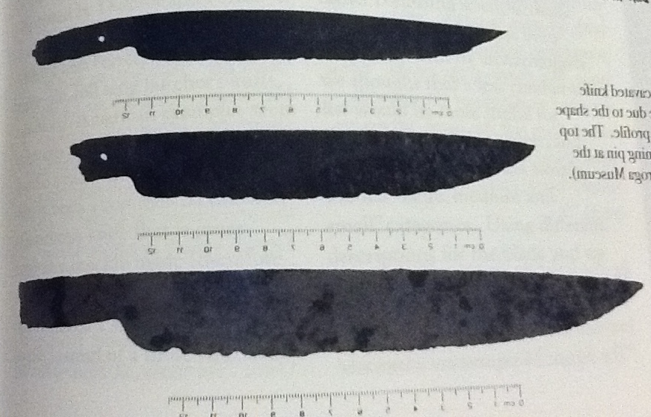
In an Illinois context, examples have been found at the Duckhouse Site in Cahokia.  The three Duckhouse Site examples shown below are from French Colonial Cahokia 1765 - 1800.  Although the date is a bit late for my use, I believe it is worthy of note because a knife that was dropped or lost in that period may have been manufactured in an earlier year closer to my target date of 1750.  


Note the half-tang construction
Image from At Home in the Illinois Country by Robert F. Mazrim (page 67)
Now let's compare the blade profiles to dug examples from Ticonderoga in the Gladysz/Hamilton article:  


Image from "French Knives in North America: Part III" Journal of the Early Americas,  Volume I, Issue VI (page 14)
Flipped horizontally for comparison

Something sticks out right away when I compare the two photos.  The top knife from the Duckhouse site has a VERY pronounced upward sweep to the blade.  From my understanding that is a tell-tale sign of an English scalper/trade knife.  Choosing an English knife in French territory appears to be completely correct.  After all, global trade was in full swing and on the flip side of things, the English bought boucherons from the French and continued to ship them to the English colonies even after the French and Indian (Seven Years) War according to Gladysz and Hamilton.  

The next thing that stands out is the use of the half-tang construction on both sets of examples.  The examples found in Cahokia seem to lack the pin holes that are prominently shown in the lower picture, but it may be the bubbling oxidation covering the holes.  

Now to apply it to my goal: There is written proof in primary documents of hunting knives in the Pays des Illinois.  There are local archaeological examples have been dug from around the target time period. Secondary source research shows that the boucheron was prolific throughout North America.  It sounds like a safe bet to add one to my kit!  

When a boucheron became available from Ken Hamilton, I snatched it up!  They sell like hot-cakes!  Besides co-authoring the articles about French knives, he also produces excellent reproductions of period items.  In this case, I received a medium boucheron and sheath.  No detail is overlooked:  all measurements are in French "pouce" (1 pouce = 1 1/16 inch), the handle is made of boxwood and it has actual French makers marks.  Here it is!


Overall length is 10 inches, with a 6 1/8 inch blade

Note the half-tang construction detail


Wowee!  Even the sheath is pretty!  

I keep begging Ken to make a large boucheron for me.  Perhaps he will read this and continue to hear my plea!  I do love my medium boucheron!  The quality is superb.  

If you are interested in learning more about Colonial French artifacts found in the Illinois Country, Robert F. Mazrim's book entitled At Home in the Illinois Country is unbeatable!  This title and several others are available from my friends at the Fort de Chartres Store.  Please check out all they have to offer:  


Fort de Chartres Store Website


I also recommend a subscription to Journal of the Early Americas. They are by far the most professional publication of research for living historians.  The articles on French knives and axes alone have been worth the subscription!  


Sunday, July 1, 2012

Mitasses/Leggings

From the Kaskaskia Manuscripts Notarial Records found in The Village of Chartres in Colonial Illinois 1720-1765 pg. 807, K-342:

List of what was sent to me from Cahors, belonging to the late LaFrance, who died in the said place, 30th day of March, 1723.
One old gun.
One jerkin.
One poor pair of red leggings.
One poor pair of linen breeches. 
Some linen breeches that no one wants. 
One pair of leggings adjudged to Leveille-- 18. paid
One lined suit adjudged to Dessablons--    50. 
One Gun adjudged to Beausoleil--             46. paid
                                                                114

Page 926, record K-432:

Sale of (ms. damaged) Monsieur de Frenchomme, officer of this garrison, done at Fort de Chartres on the sixth of August one thousand seven hundred twenty-eight.
One pair of breeches of Petersburg adjudged to Monsieur de St. Ange at one hundred sols ... 5. 
One waistcoat and one pair of old black silk stockings, adjudged to Monsieur Chassin at nine francs ... 9.
One pair of leggings, one pair of shoes and one shot pouch of black kidskin decorated with porcupine quills, adjudged with one calico handkerchief to Monsieur de Terisse at ten francs ... 10.

There appears to be enough primary source proof in the Kaskaskia Manuscripts that leggings/mitasses were a fairly common item, so I decided to make a pair!  

The only color that I found when glancing through the HUGE (like 1000 pages huge...) Village of Chartres book was the set of red leggings listed above.  It would make the best sense to make a pair of red leggings, but wouldn't you know it, I have an excess of really nice indigo broadcloth.  So now I'm probably doing a "no-no" for a good living historian in trying to prove something that I already have as being correct for the time/place.  

From my initial research on the Pays des Illinois, many of the early settlers of the Kaskaskia area came south from Canada.    My assumption (yes, I know...) is that the Mississippi River provided a highway for the transportation of both goods and cultural ideas, so it would be expected that much of the clothing would resemble items worn by the French in Canada.  New Orleans in the south was not founded until 1718, so much of the cultural "sharing" in the early times of the Illinois Country would have had to come from the northern reaches of New France.

In short, if certain types of clothing and cloth is available in the upper parts of New France, then it probably would have appeared in the Kaskaskia area.  

From the introduction of The Equipment of New France Militia 1740-1760 by Steve DeLisle:

The clothing issued to the militia on campaign was no different than what a voyageur or any traveller from New France would have worn.  Generally speaking, it is a hybrid between a western French sailor's clothing and Amerindian clothing designs which were well adapted to the environment.  

From Costume in New France, 1740-1760: A Visual Dictionary by Suzanne and Andre Gousse, page 66:

Parish of Saint-Antoine-de-Longueuil
S1747-06-27
The body of a man found drowned in the Sault St-Louis opposite the house of Andre Lamarre; approximately five feet and a half tall, long auburn hair with a braid held against the head with a rosary, a shirt of common linen, a pair of breeches of homespun linen, a white short waistcoat, another brown one and a waistcoat fastened with a double row of pewter buttons, blue leggings

Now that I've researched and second-guessed myself into the ground, let's actually do something and make some mitasses!  

The first thing I did was cut the legs out of some old dress pants to use as a pattern before cutting up the good material.
  
Using a pattern before cutting the good stuff! 

Using the old pant leg, I wrapped it around my leg and safety-pinned it on the side of the leg where the seam was to be sewn.  It took a little adjusting and an allowance had to be made for moving/squatting in the leggings, so be sure to move around while fitting the pattern!  A far as height goes, I measured to mid-thigh.  

DeLisle's book mentioned above gives a great description of leggings on page 6.  There are measurements given that show how a Milice soldier was to cut apart his allowance of issued wool to make a pair.  Unfortunately, these measurements will not work for me as I am no where near the size of an 18th century Frenchman!  Custom fit with my makeshift pattern will have to do for now.  

It is mentioned, however, that "...leaving on the side an excess of material 'four fingers wide'.  They went up to mid-thigh."  A four-finger excess measures out to 2 1/2" to 3" and can be seen in my pattern.  The marker line is where the seam will be, with the excess material being the side flaps.  

Once the pattern is made, cut the wool to size.  On a straight cut of material, a period method was to pull a single thread from the cloth and tear at the area where the thread is missing.  Since the mitasses pattern is angled to allow a taper on the leg, I was unable to do this, but it worked well for making the garters to hold up my leggings near the end of the project!  

Cutting the broadcloth

After cutting the broadcloth from the pattern, I pinned the flap edges together and tried the leggings on for a final check before sewing.  Once the fit was right, a chalk line was drawn for my stitches to follow.  

Wool folded before pinning
Measuring the "Four Finger Width" for the side flaps

Leggings pinned for a final fit before sewing
Time to sew!  I used a medium-weight natural linen thread, waxed with beeswax to prevent fraying and make sewing easier.  The stitch was a backstitch, which can be learned by watching a youtube video!  


A tip to sewing is to use a length of thread that is about your arm's length and not longer.  This makes knotting less likely when pulling your thread through the material.  It is easy to start out with a long thread, thinking that you'll not have to finish and start new threads as often, but for me, I waste more time trying to undo knots and fighting the excess thread.    An arm's length from chest to fingertips works great!  

My backstitch.  Not pretty, but I'm practicing!
Stitch each seam on each legging and then it is time to add the garters that will be used to hold them up.  No one wants their mitasses on the ground.  That's just embarrassing.  

For the garters, I used the same broadcloth, tearing 1" strips by about 30" in length.  I figured they could always be shortened if too long.  The strip is then sewn just behind seam on each legging.  

Garter is 1" wide by 30" long

Garter sewn to back part of legging

Back side of legging, showing the rear of a backstitch and the garter stitching
That pretty much sums up my legging project.  I am open to legitimate suggestions, with research being a plus!  Additional research is most helpful to me.  Again, this is just a personal journey of a guy that really doesn't know what he is doing, but is willing to learn!  

The final set of leggings.  I may have strayed from my chalk line on the left legging... or I may have a weird bump on my thigh there.  I'm not telling which one is the case!  


If you wish to learn more about 18th century sewing techniques, I highly recommend the set of books by Kannick's Korner.  


The Lady's Guide to Plain Sewing is a great resource for basic stitches and just starting out in hand-sewing.  There is a second Lady's Guide in the series as well as a Workman's guide.  I personally find the Lady's Guides to be most helpful!  They are small books (around 30 pages), but show the details needed to construct 18th century clothing.  

Jeff Pavlik was kind enough to allow me to link to his instructions for brayet and mitasses construction.  Thanks Jeff! 

Jeff's main site, colonialbaker.net, has been an inspiration for my postings and direction in the hobby.  Be sure to view his work.  He is a very talented fellow!   


Saturday, June 30, 2012

French Homes in the Illinois

It has been quite some time since the last post and I wanted to share this link to a very comprehensive list of primary and secondary sources on the Illinois Country during the time of the French.


As far as my progress goes on creating a 1750 French habitant kit, I have created a set of blue broadcloth mitasses and a brayet.  It is overdue that I post some pictures of the projects and some research.

On another topic, I did get a chance to visit the historic district of Ste. Genevieve, Missouri a few weeks ago.  There is a collection of French homes dating from the late 18th and early 19th century that are rather interesting to look at.  A couple of the examples are the poteaux-en-terre and the poteaux- sur-solle types of construction.  I like to call them a typical French log cabin of the time.  You'll notice the structures are built of vertical logs.  

Model of Bolduc House, poteaux sur solle construction

Bolduc House in Ste. Genevieve, MO

Model of poteaux en terre construction

Bequette-Ribault House located on St. Mary's Road near Ste. Genevieve, MO